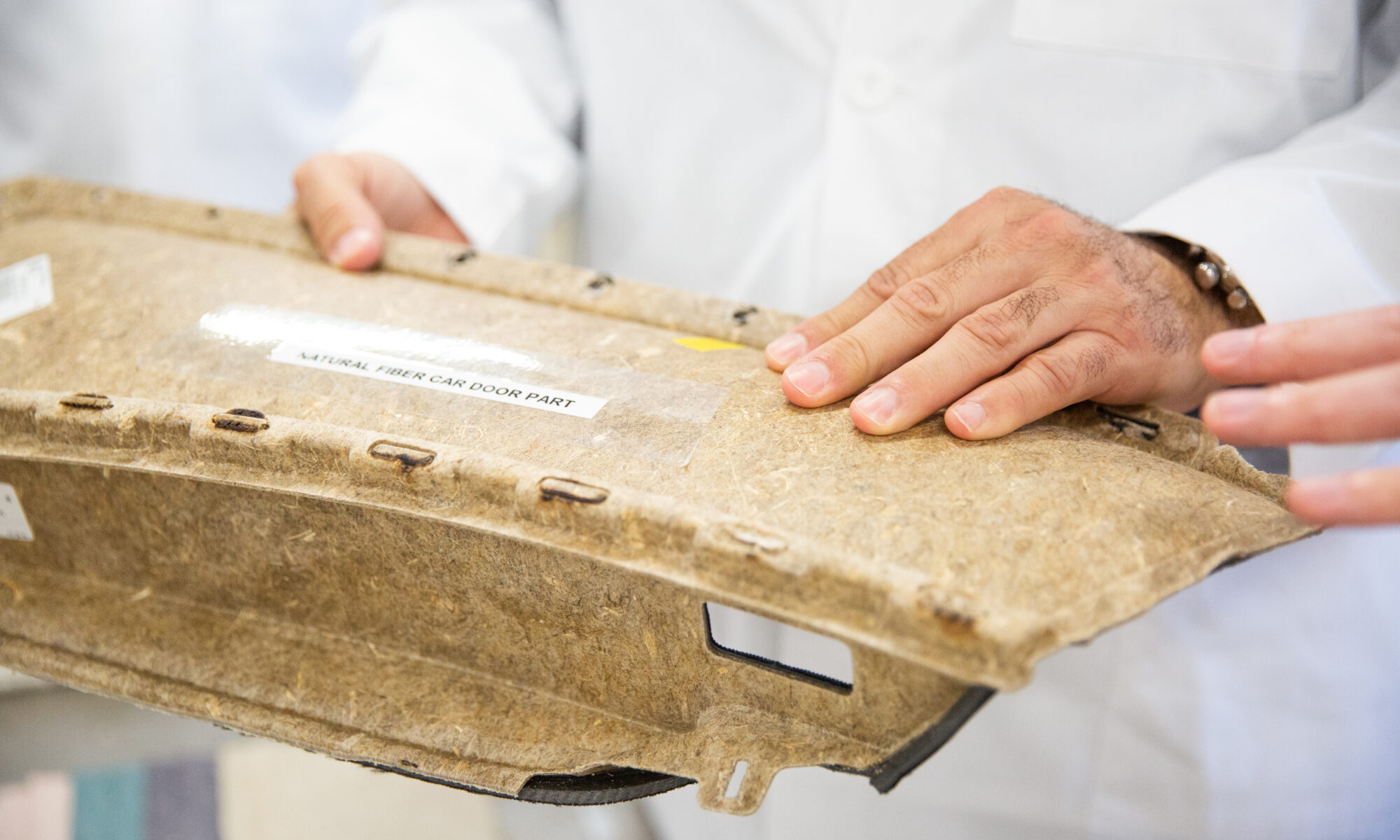
Optimizing compression molding for paper fiber-reinforced polypropylene composites
This work optimizes compression molding manufacturing for wet-formed nonwoven paper and polypropylene fiber mats. A central composite designed experiment investigated the effects of fiber reinforcement concentration, compression molding temperature, pressure, and time on composite laminate performance. We assess the composites’ density, panel thickness, water uptake, flexural behavior, and Izod impact strength. Models predicted and optimized composite performance using objective function analysis with penalties applied for undesirable conditions, such as processing time or low reinforcement concentration. Paper fiber content has the largest impact on composite properties, followed by processing time, molding pressure, and temperature. Composite optimization depends on penalty conditions; low fiber content penalties favor low fiber content panels with short processing times, while high fiber content penalties favor high fiber content panels with long processing times. This work suggests that molding composites with a greater fraction of renewable feedstock requires a commensurate increase in processing intensity.
Grubb, C. A.; Keffer, D. J.; Webb, C. D.; Kardos, M.; Mainka, H.; Harper, D. P. Paper Fiber-Reinforced Polypropylene Composites from Nonwoven Preforms: A Study on Compression Molding Optimization from a Manufacturing Perspective. Composites Part A: Applied Science and Manufacturing2024, 185, 108339. https://doi.org/10.1016/j.compositesa.2024.108339.
Developing a recycling process for paper fiber-reinforced polypropylene composites useful for automotive parts
The automotive industry is under growing pressure from regulatory agencies to improve the recyclability of its plastic components. Simultaneously, manufacturers are adopting natural fiber composites in vehicles to reduce their carbon footprint and decrease reliance on petroleum-based materials. This presents a challenge at vehicle end-of-life, however, as natural fiber-reinforced polymers are substantially more difficult to recycle than their unreinforced counterparts. This study investigated the development of a mechanical recycling process for paper fiber-reinforced polypropylene composites, focusing on the impact of injection molding parameters—specifically, injection temperature and rate—on the thermal, mechanical, and water uptake properties of the composites. The results showed that processing temperature had a greater influence on composite performance than injection rate, with some limited interaction effects between the two. Higher processing intensity damaged the paper fibers, increasing the number of nucleation sites and resulting in greater polypropylene crystallinity. These structural changes reduced tensile properties at higher intensities, while flexural properties improved. Objective function analysis was applied to identify optimal processing conditions, balancing these competing trends. Overall, the findings demonstrate that paper fiber-reinforced polypropylene composites can be recycled into automotive-relevant injection molding compounds using conventional plastic manufacturing techniques, though careful tuning of processing parameters is essential to achieve optimal performance.
Grubb, C. A.; Mokhtarnejad, M.; Greene, J.; Misasi, J.; Keffer, D. J.; Kardos, M.; Mainka, H.; Harper, D. P. Development of an Automotive-Relevant Recycling Process for Paper Fiber-Reinforced Polypropylene Composites. Recycling 2024, 9 (6), 126. https://doi.org/10.3390/recycling9060126.