Turning CO₂ Into Something Useful
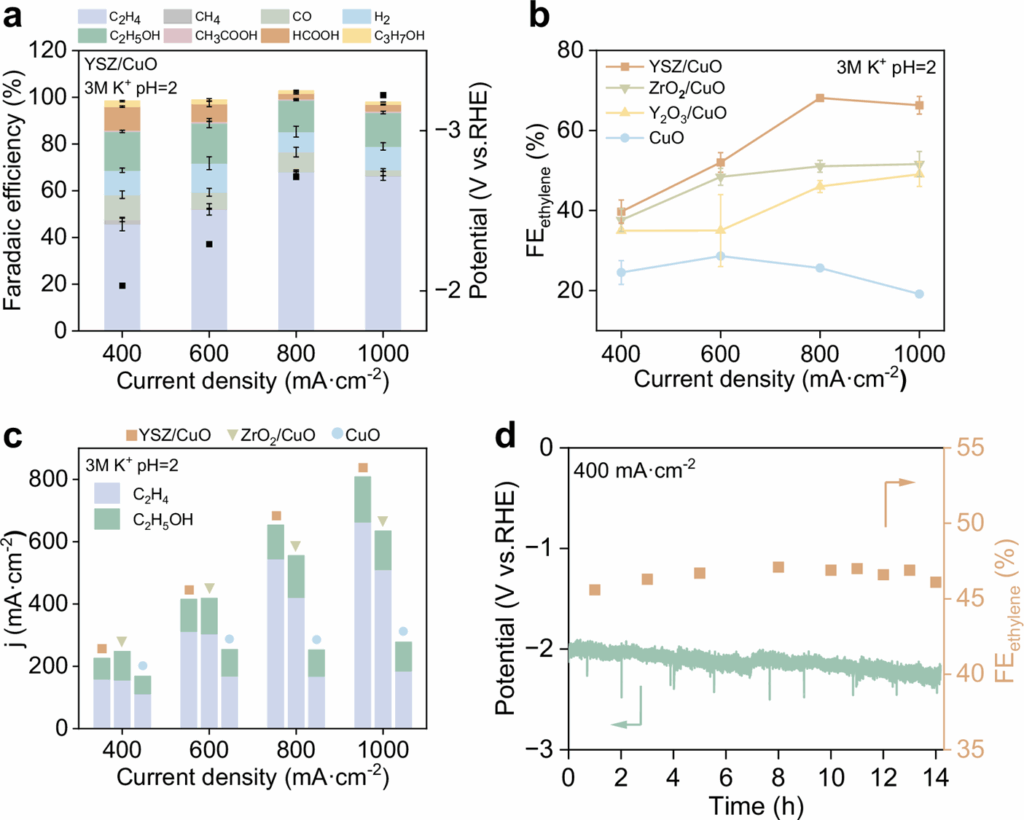
Asst Prof Zihao Zhang is leading the FACt lab (Fundamental & Applied Catalysis) to explore a simple but urgent question : How can we turn the CO₂ warming our atmosphere into something valuable? In a newly published collaborative study in Nature Communications, Zhang along with co-authors report a promising breakthrough – efficiently converting CO₂ into ethylene with nearly 70% selectivity. Ethylene is a building block for everyday products ranging from packaging to textiles. Instead of depending on fossil resources, this approach points to a future where essential chemicals can be produced from carbon waste.
The heart of the discovery lies in a clever materials design. The team dispersed copper on yttrium-doped zirconia (YSZ) support, creating a unique Cu–support interface that keeps copper in a cationic nature, highly active for CO₂ conversion; however, calculations indicate that cationic Cu tends to reduce into metallic copper under harsh acidic conditions. The introduction of yttrium generates oxygen vacancies in zirconia, which help “anchor” these cationic copper sites and prevent over-reduction to metal. This stability allows the catalyst to continue performing the challenging C–C coupling chemistry required to turn CO₂ into ethylene with exceptional efficiency, even in strongly acidic media where most catalysts fail.
The result is more than a technical achievement, it’s a glimpse of a cleaner future. By illustrating a method to keep cationic copper stable where it normally fails, this research shows a new pathway for carbon-recycling technologies to contribute to sustainable production of fuels and chemicals.